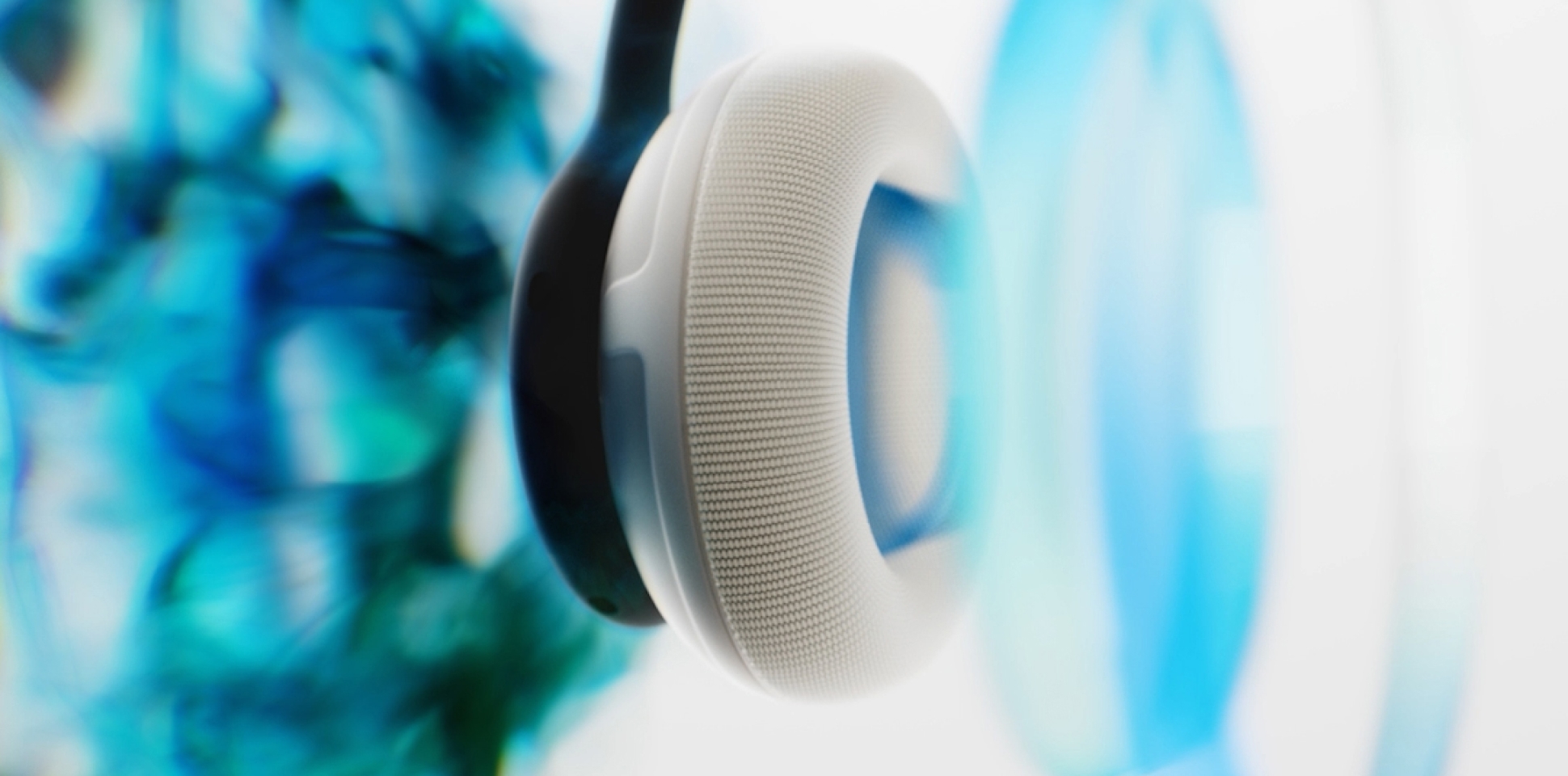
Two listening modes, one array of microphones.
Sitting back on a flight, you want the engine noise gone. Standing at a coffee counter, you want to hear the person taking your order.
Active Noise Cancellation (ANC) and Transparency mode are two of the most sought-after features on headphones, and for good reason. These listening modes let you control your sound how you want, when you want, tuning out the world around you so that you can focus, or letting you listen to music without losing awareness of your environment.
What is Active Noise Cancellation (ANC)?
Active Noise Cancellation, or ANC for short, is how headphones take your surroundings out of what you hear. ANC uses feed-forward microphones, feedback microphones, and an internal digital processor (DSP) to listen to and analyze the noise around you, then plays a complementary sound wave back that cancels the unwanted noise before it reaches your ears. Soft, high-quality ear cushions form a snug fit around your ear to create an acoustic seal that blocks sound on its own, which is called passive noise cancellation. But the “A” in ANC stands for active. It actively listens, computes, and then generates opposing sound waves that cancel the noise rather than covering it up.
Active Noise Cancellation reacts to what you’re doing and where, so it’s designed to adapt to your environment. Noise over a long flight or across a workday are never the same. Both Beats 360 and Beats Studio Pro adapt to your environment and unique fit, so every time you start listening to music, you'll get an optimal noise cancellation response. Beats Studio Buds + has the same capability, just in earbud form. Powerbeats Pro 2 and Powerbeats Fit are made for active lifestyles and also come equipped with adaptive ANC to block external sound and help give you absolute focus.
What is Transparency mode?
Transparency mode is a sound setting that assigns those same microphones used for ANC to the opposite task, identifying and blending the sound of your surroundings with what you’re listening to, so that you can hear what’s going on around you without taking your headphones off.
Every product we make with Active Noise Cancellation also has Transparency mode, including Beats 360, Beats Studio Pro, Powerbeats Pro 2, Powerbeats Fit, and Beats Studio Buds +.
With these Beats headphones and earbuds, you can easily switch to Transparency mode to let the sounds of your environment mix seamlessly with your music when you want to stay present and aware.
With Transparency mode on, you’ll still be able to hear somebody when they call your name. You can stay more aware of your surroundings, like in an outdoor city setting. You can keep talking to someone without breaking stride or pausing a track. Your music stays on and your environment blends in and feels natural.

Which mode should you use, and when?
For studying, use Active Noise Cancellation, which removes the steady background noise of a library, a café or a shared room so that what’s left is your music and the page in front of you. For an open-plan office, Active Noise Cancellation can also be the mode you want when you need to focus, since the sound of an office is mostly steady (ventilation, keyboards, the low wash of other people's conversations), and steady sound is exactly what ANC removes best.
On an airplane, Active Noise Cancellation truly shines, because engine noise contains steady, low-pitched (bass) hum; low-frequency sounds like this are the easiest for ANC to cancel. Overall noise blocking comes from two layers working together: passive isolation, where the ear cushions / ear tips physically seal out sound, and active cancellation, where ANC uses microphones to detect and decrease whatever noise gets through that seal. Both Beats 360 and Beats Studio Pro pair comfortable ear cushions with Active Noise Cancellation, delivering an incredibly effective combination of passive seal and active processing.
If you prefer in-ear designs with comfortable ear tips, Powerbeats Pro 2, Powerbeats Fit, and Beats Studio Buds + all support Active Noise Cancellation and Transparency modes as well.
For situational awareness, like when commuting for example, you can use Transparency mode to hear announcements, traffic and the person next to you while your music keeps playing.
What does Adaptive EQ do?
Adaptive EQ is designed to ensure a consistent and rich listening experience. This feature uses inward-facing microphones to pick up how your device(s) are actually fitting over (or in) your ears, then adjusts the sound to match your fit in real time, so the music sounds right whether your personal acoustic seal is perfect or not. In other words, the system continually adjusts based on the acoustic relationship between the headphone and your ears, allowing the tuning to adapt to you.
Beats 360 supports Adaptive EQ mode when ANC and Transparency are turned off, continuously scanning your individual fit and seal and adjusting acoustic frequencies for incredible, personalized sound.
No two heads are the same shape, and a headphone that sounded right in the store can sound different later if it’s shifted position. Adaptive EQ helps to keep your headphones sounding great based on how they personally fit you.
Frequently Asked Questions
How do I use noise cancellation properly?
To use noise cancellation properly, get the fit right before you pick the listening mode: seat the ear cushions fully around your ears, or push the ear tips in until the seal feels closed, because Active Noise Cancellation works by analyzing whatever sound gets past that physical acoustic seal.
After that, switch modes as your surroundings or priorities change: Active Noise Cancellation when the noise is steady and you want to focus, Transparency mode when you want to hear more of what’s going around you, in a way that feels natural.
Is ANC worth it for everyday use?
Active Noise Cancellation is worth it for everyday use in scenarios where you want to focus. It can be especially worth it if your days include a commute, an office, an open room, or a flight, because those are steady-noise environments and steady noise is what Active Noise Cancellation removes best. ANC can also help you avoid the occasional inclination to simply raise the volume on your music to cover up external noise.
Which Beats products have ANC and Transparency mode?
Five Beats products have both Active Noise Cancellation and Transparency mode: Beats 360 and Beats Studio Pro over-ear headphones, and Powerbeats Pro 2, Powerbeats Fit and Beats Studio Buds + earbuds. Every product we build with Active Noise Cancellation also comes with Transparency mode.
Does Beats Solo 4 have noise cancellation?
Beats Solo 4 does not have Active Noise Cancellation or Transparency mode. It blocks external sound passively only, through the seal its ear cushions form on your ears. For Active Noise Cancellation in a headphone, choose an over-ear design like Beats 360 or Beats Studio Pro.
Do Beats Solo Buds or Beats Flex have ANC?
Beats Solo Buds and Beats Flex do not have Active Noise Cancellation or Transparency mode. Three of our earbuds do have both: Powerbeats Pro 2, Powerbeats Fit and Beats Studio Buds +. Beats Solo Buds and Beats Flex have ear tips which create a comfortable, snug fit that provides passive noise cancellation.
Does noise cancellation drain the battery?
Active Noise Cancellation (ANC) does use power, because the microphones and the processing that work to cancel external noise run while ANC is enabled.
Battery life varies by headphone model: Beats Studio Pro delivers up to 40 hours with ANC and Transparency mode off, and up to 24 hours with either one on.1 Beats 360 features up to 32 hours with ANC on or in Adaptive EQ mode, while in Transparency mode, it delivers up to 24 hours of battery life.2
Is Spatial Audio a listening mode?
Spatial Audio is not a listening mode; it’s actually a technology that brings theater-like sound from the movie or video you’re watching, or the Dolby Atmos song you’re listening to. Spatial Audio can work alongside all three listening modes.
1 Testing conducted by Apple in May 2023 using preproduction Beats Studio Pro units and software paired with iPhone 13 units and prerelease software. The playlist consisted of 358 unique audio tracks purchased from the iTunes Store (256-Kbps AAC encoding). Volume was set to 50% and Active Noise Cancellation and Transparency were turned off. Testing consisted of full Beats Studio Pro battery discharge while playing audio until Beats Studio Pro stopped playback. With Active Noise Cancellation turned on, listening time was up to 24 hours. Battery life depends on device settings, environment, usage, and many other factors.
2 Testing conducted by Apple in August 2026 using preproduction Beats 360 units paired with combination of iPhone 15 Pro and iPhone 15 Plus units, all with prerelease software. The playlist consisted of 358 unique audio tracks purchased from the iTunes Store (256-Kbps AAC encoding). Volume was set to 50%, Active Noise Cancellation was enabled, with Spatial Audio and head tracking enabled. Testing consisted of full Beats 360 battery discharge while playing audio until the Beats 360 stopped playback. With Active Noise Cancellation turned on or with Adaptive EQ, total battery life is 32 hours of continuous playback. In Transparency mode, total battery life is 24 hours of continuous playback. Battery life depends on device settings, environment, usage, and many other factors.